
How the Bank Credit System Actually Works: Where the Money Really Goes
What actually happens when a bank lends money, and the exact chain of events when it never comes back.
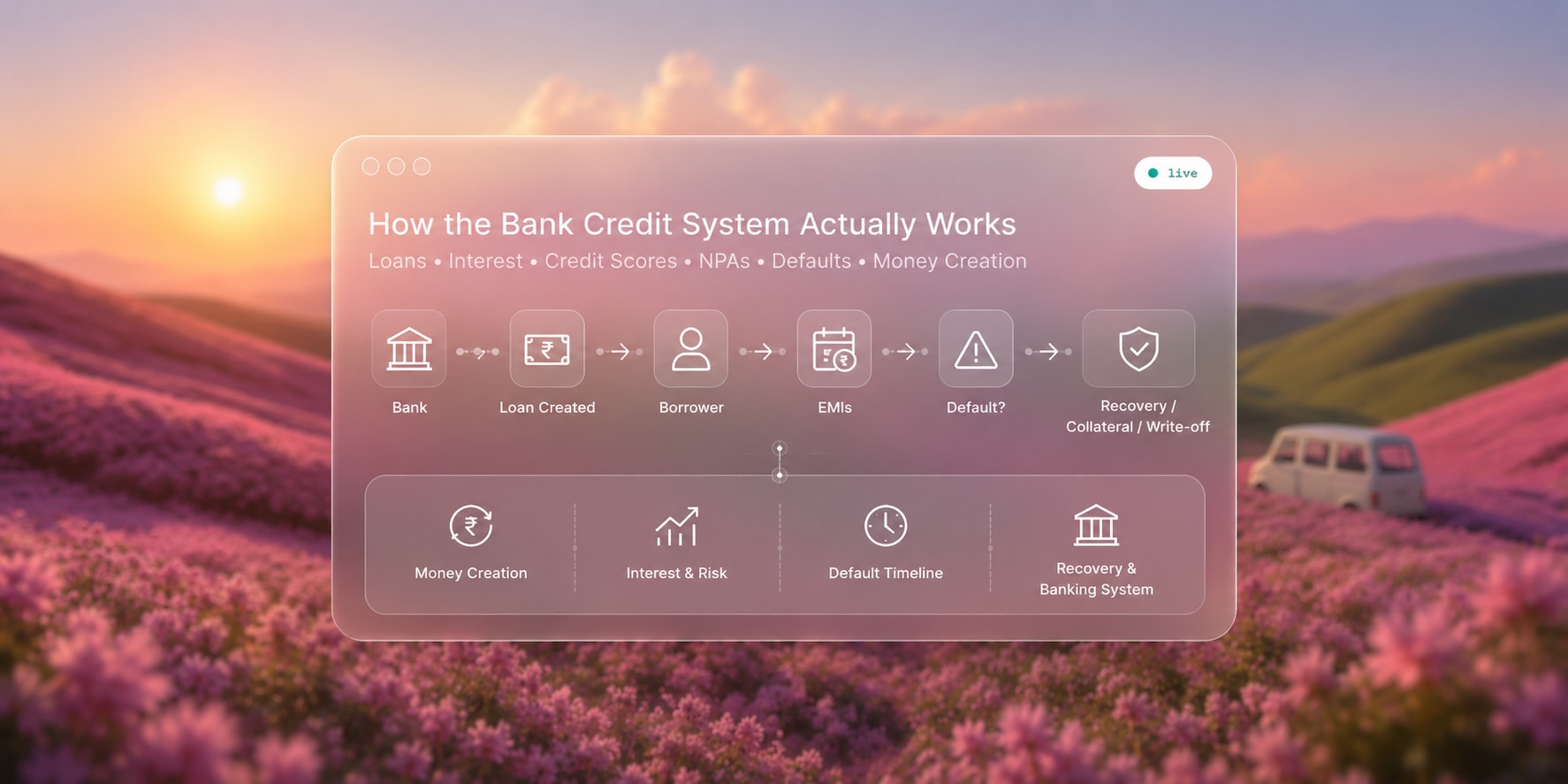
Why This Matters
Most people interact with banks their whole lives without understanding what a bank actually does when it "gives" you a loan. Even fewer understand what happens on the other side when someone can't pay it back.
This isn't a niche topic. It affects your credit score, your interest rates, the health of the economy you live in, and sometimes even your tax bill. This piece walks through the entire system end to end, in plain language, with real examples and every technical term explained the first time it appears.
The Thing Nobody Tells You: Banks Create Money
Here's the first surprising fact. When a bank gives you a loan, it is not handing you money that someone else deposited.
Picture Rahul walking into a bank and getting approved for a ₹10 lakh home loan. The bank doesn't open a vault and take out cash that belongs to some other depositor. It simply types "₹10,00,000" into Rahul's account. That number did not exist anywhere before this moment. It was created.
This is called credit creation, which is the process by which new money enters the economy through lending, rather than through the government printing currency. It sounds strange, but it is exactly how modern banking works everywhere in the world, not just in India.
Naturally, this raises a question: if banks can just create money, what stops them from lending infinite amounts? Two regulatory limits answer that.
Capital Adequacy Ratio (CAR): Set by the RBI (Reserve Bank of India) under global Basel III banking standards, this requires banks to hold at least 9% of their total loans as their own real capital (money the bank's owners have put in, not deposits). So for every ₹100 a bank lends, at least ₹9 must be backed by the bank's own equity. This is the primary brake on unlimited money creation.
Cash Reserve Ratio (CRR): Currently 4%, this is the percentage of total deposits every bank must physically park with the RBI, earning no interest. It cannot be lent out.
Statutory Liquidity Ratio (SLR): Currently 18%, this requires banks to hold that portion of deposits in safe government securities. Again, this money isn't available for lending.
Together, CRR and SLR ensure banks always keep a liquidity cushion, while CAR ensures they have enough owned capital to absorb losses if loans go bad.
How a Bank Decides Whether to Lend You Money
Before any credit is created, the bank runs what's called credit appraisal or underwriting, which is a structured risk check. This is usually explained through the 5 Cs of Credit:
Character: Your track record of repaying past debts. In India, this is captured by your CIBIL score, a three-digit number between 300 and 900 generated by credit bureaus like CIBIL, Experian, and Equifax based on your entire borrowing history. A score above 750 is generally considered good, while below 650 makes borrowing expensive or impossible.
Capacity: Your ability to repay from your actual income. Banks calculate something called FOIR (Fixed Obligation to Income Ratio), which is the percentage of your monthly income already committed to EMIs (Equated Monthly Installments). Most banks want your FOIR, including the new loan, to stay under 40 to 50%.
Capital: How much of your own money you're putting into the purchase. For home loans, banks typically fund 75 to 80% of the property value through what's called the Loan-to-Value (LTV) ratio, with you paying the rest upfront. A lower LTV means less risk for the bank.
Collateral: What the bank can legally seize if you stop paying. A home loan is backed by the house. A car loan is backed by the vehicle. A personal loan has no collateral at all, which is exactly why personal loans carry interest rates of 12 to 24% compared to 8 to 10% for home loans. The bank is pricing in the risk of having nothing to recover if you default.
Conditions: The broader economic and industry context. A loan to a business in a struggling sector during a slowdown is inherently riskier, regardless of that specific borrower's history.
Based on this appraisal, the bank assigns you (or a company) an internal credit rating, which in turn determines the loan's interest rate and how much money the bank must set aside as a safety buffer against it.
How Your Interest Rate Is Actually Built
Your interest rate isn't a single number pulled out of thin air. It is constructed in layers.
The base layer is the External Benchmark Lending Rate (EBLR), which in India is tied to the RBI's Repo Rate (the rate at which the RBI lends money to commercial banks, currently 6.25%). Since October 2019, RBI has mandated that retail loans be linked to this external benchmark rather than internal bank rates, making rate changes more transparent and immediate for borrowers.
On top of this floor, the bank adds a Credit Risk Premium based on your specific risk profile. A borrower with an excellent credit score might pay Repo plus 0.5%. Someone with a shakier history might pay Repo plus 6%.
Then comes a Term Premium. Longer loans carry more uncertainty over time, so a 20-year loan typically costs more than a 5-year loan for the same borrower.
Finally, the bank adds its operating costs (the expense of running branches, staff, and collections) and its profit margin.
Add all these layers together, and you get the final rate quoted to you. This is why two people can apply for identical loan amounts on the same day and receive very different rates. The layers stacked on top of the base rate are different for each of them.
What a Loan Looks Like on the Bank's Books
Once money is disbursed, the loan sits on the bank's balance sheet as an asset because it represents money owed to the bank. The RBI requires every bank to classify these assets into categories under what's called the IRAC norms (Income Recognition and Asset Classification):
Standard Assets: Loans being repaid on schedule, no signs of stress. Banks set aside a small general provision, roughly 0.25 to 0.40% of the loan amount, just as a routine buffer.
A provision is money a bank sets aside from its profits as a cushion against expected losses, before those losses actually happen. Think of it as an insurance reserve the bank builds against itself.
Sub-Standard Assets: A loan where payments have been overdue for more than 90 days but less than 12 months. Provisions jump sharply here, around 15% of the loan if it's backed by collateral, and 25% if it isn't.
Doubtful Assets: Overdue for more than 12 months. Provisions can range from 25% to 100% depending on how long the loan has been troubled.
Loss Assets: The bank has essentially concluded this money will never be recovered. 100% provision, meaning the bank treats the entire loan as gone for accounting purposes, even while legal recovery may continue.
The single most important threshold in this entire system is the 90-day mark. Once a loan's principal or interest is overdue for more than 90 days, it officially becomes an NPA (Non-Performing Asset). This term will come up repeatedly, and it is the formal trigger for everything that follows.
The Timeline of a Default: What Actually Happens
A default isn't a single event. It's a slow-moving process that unfolds over months, sometimes years. Here's exactly how it plays out.
Days 1 to 30 (Soft delinquency): The borrower misses a payment. Automated reminders go out by SMS, email, and phone. The loan is still classified as "Standard" on the bank's books. Nothing serious has happened yet, this occurs to a small percentage of borrowers every single month and is treated as routine.
Days 31 to 60 (Early bucket): Still unpaid. The bank's collections team escalates, sometimes with field visits. At this stage, banks are often willing to offer restructuring (changing loan terms, extending tenure, temporarily reducing EMI, or pausing payments for a defined period) specifically to avoid the loan crossing into NPA territory, because once it does, the accounting consequences are severe for the bank too.
Days 61 to 89 (Late bucket, pre-NPA): Serious internal escalation. Many banks run dedicated Early Warning Signal (EWS) teams that watch for stress indicators like bounced cheques, falling account balances, tax filing lapses, trying to catch trouble before the 90-day cliff.
Day 90 (NPA declared): This is the pivot point. Several things happen at once. The bank stops booking interest as income. Until now, every day of accrued interest was counted as profit on paper, even if not yet collected in cash. From this point, that stops, the money owed goes into a suspense account rather than being counted as earnings.
Provisions increase dramatically, jumping from a fraction of a percent to 15 to 25% of the loan value, taken directly out of the bank's profit for that quarter. This is why banks with rising NPAs report worse quarterly results even though no new cash actually left the building. It's an accounting recognition of expected future losses. The borrower's CIBIL score collapses, often dropping 100 to 150+ points, making future borrowing difficult or impossible for years.
Months 3 to 12 (Recovery attempts): The bank now pursues parallel paths depending on the loan type.
One-Time Settlement (OTS): The bank negotiates directly, often accepting less than the full amount owed (a "haircut") in exchange for closing the matter quickly rather than pursuing lengthy legal recovery.
SARFAESI Act, 2002: For secured loans above ₹1 lakh, this law allows banks to take possession of the pledged collateral and auction it without needing a court order, after giving the borrower a 60-day notice period. This is the mechanism behind most home and vehicle loan recoveries in India.
Debt Recovery Tribunal (DRT): For loans above ₹20 lakh, banks can approach this specialized fast-track court built specifically for debt recovery cases.
Insolvency and Bankruptcy Code, 2016 (IBC): Used for corporate defaults. Lenders can push a company into insolvency proceedings managed by the NCLT (National Company Law Tribunal).
Beyond 12 months (Doubtful asset): Provisions climb to 25 to 100%. At this stage, banks typically choose between two paths. They might sell to an Asset Reconstruction Company (ARC), where specialized firms buy distressed loan portfolios at a steep discount (often 20 to 40% of face value) and take on the job of recovering the debt themselves. Or they might Write-off, where the bank formally removes the loan from its balance sheet to clean up its books. Critically, a write-off is not forgiveness. The borrower still legally owes the money, and recovery efforts can continue for years.
Where the Money Actually Goes: Worked Examples
This is the part almost nobody explains clearly. Let's trace the actual money in different scenarios.
Scenario A: Normal Repayment (No Default)
Rahul borrows ₹10 lakh at 9% interest over 20 years, paying roughly ₹9,000/month. Over 20 years he repays about ₹21.6 lakh total.
₹10 lakh of that is the principal, the original amount borrowed, and when he repays it, that money is effectively destroyed, reversing the creation that happened at loan disbursal. ₹11.6 lakh is interest, which is the bank's real, permanent profit.
Nobody loses here. The bank earns a fair return for taking on risk and administering the loan; Rahul gets a house.
Scenario B: Secured Loan Default (Home Loan)
Priya borrows ₹50 lakh for a ₹65 lakh house, paying ₹15 lakh upfront. After 2 years and ₹3 lakh in EMIs, she loses her job and stops paying entirely. Outstanding balance: ₹47 lakh.
Day 90, the loan becomes NPA. The bank sets aside a ₹7 lakh provision (15% of ₹47 lakh) from its own profits. The bank issues a SARFAESI notice, takes possession after 60 days, and auctions the house (which has appreciated to ₹70 lakh market value) for ₹62 lakh.
The bank recovers its ₹47 lakh principal plus accrued interest and legal costs (around ₹3 lakh), totaling ₹50 lakh, and returns the remaining ₹12 lakh to Priya.
Who actually lost money: Priya lost her original ₹15 lakh down payment and her ₹3 lakh in EMI payments, roughly ₹18 lakh gone, plus her credit score. The bank fully recovered its money. The earlier ₹7 lakh provision gets reversed back into profit once recovery is complete. In fact, because the property appreciated, the bank effectively made a small extra gain. This is why secured lending is comparatively low-risk for banks. The collateral does the heavy lifting.
Scenario C: Unsecured Loan Default (Personal Loan)
Amit borrows ₹5 lakh at 18% interest for medical bills and personal expenses, with no collateral attached. After paying ₹50,000, he stops entirely. Outstanding: ₹4.7 lakh.
Day 90, NPA declared. Bank sets aside ₹1.17 lakh provision (25%, since it's unsecured). Amit has no seizable assets and no steady income. Recovery agents and legal notices go nowhere for a year. The bank eventually writes off the ₹4.7 lakh and sells the debt to a collection agency or ARC for roughly ₹50,000 to ₹70,000.
Who actually lost money: The ₹5 lakh Amit originally borrowed had already flowed into the real economy (into hospital revenues, hotel bookings, vendor payments). That money is simply gone from the bank's perspective. The bank's net loss (roughly ₹4.7 lakh minus the ₹60,000 recovered from the debt sale) comes out of its own equity capital, meaning it is ultimately absorbed by the bank's shareholders. Amit's debt is not forgiven. The collection agency or ARC will continue pursuing him for years, and his credit history is damaged for at least 7 years.
Scenario D: Large Corporate Default
A company, ABC Infrastructure Ltd, borrowed ₹2,000 crore collectively from 8 banks to build highways. The project fails and the company cannot repay.
All 8 banks declare NPA and collectively set aside ₹300 to ₹500 crore in provisions, hitting all their quarterly results simultaneously. The banks form a Joint Lenders Forum, initially reject a lowball One-Time Settlement offer, and instead push the company into NCLT insolvency proceedings under the IBC.
After 12 to 18 months, the only serious buyer offers ₹1,100 crore for the entire company and its assets. Banks approve this, recovering roughly 55% of what's owed. After legal and resolution fees, the recovered ₹1,080 crore is distributed proportionally among the 8 banks based on how much each lent.
Who actually lost money: Each bank's shareholders absorb their share of the shortfall. If the lead bank (say SBI, which is majority government-owned) lent ₹600 crore and recovers only ₹324 crore, that ₹276 crore loss eats into SBI's equity. Since the Government of India owns the majority stake in SBI, it typically injects fresh capital to restore SBI's financial health, and that capital comes from taxpayer money. The remaining ₹920 crore that was never recovered had already been spent on cement, wages, and contractor payments, and simply never returned to the lending banks.
Who Ultimately Bears the Loss
This is where the system differs quite sharply depending on who owns the bank.
Government (PSU) Banks
Examples: State Bank of India, Punjab National Bank, Bank of Baroda.
When these banks accumulate large losses, the government (as majority shareholder) injects fresh capital to keep them solvent. This is called recapitalization, and the money comes directly from the public exchequer, meaning ordinary taxpayers. Between 2017 and 2021, the Government of India recapitalized PSU banks with over ₹3.5 lakh crore following a major NPA crisis where bad loans peaked at 11.6% of total lending.
Listed Private Banks
Examples: HDFC Bank, ICICI Bank, Axis Bank.
These banks cover losses primarily by raising fresh equity by selling new shares to public market investors through mechanisms like rights issues or follow-on public offers. Existing shareholders may see their ownership diluted, and the bank's stock price typically falls when trouble becomes visible, which acts as an early public warning sign. No taxpayer money is directly involved unless the situation becomes systemic.
Unlisted Private Banks
Examples: smaller regional private banks, many urban cooperative banks, some early-stage small finance banks.
These institutions can't raise money from public stock markets since they aren't listed. Their options, roughly in order of preference, start with Internal reserves, which are profits retained over previous years, used first to absorb losses quietly.
Next is a Rights issue to existing private shareholders where the bank asks its existing promoters, family owners, or private investors to inject additional capital directly. Then a New private investor or strategic buyer where if existing owners can't fund the gap, the bank seeks a new investor willing to inject capital in exchange for an ownership stake.
Finally, RBI intervention occurs if no private capital can be found and the bank is at risk of collapse. The RBI can impose Prompt Corrective Action (PCA) or force a merger with a healthier bank, transferring deposits and assets to the acquirer.
The Universal Safety Net: DICGC
Regardless of whether a bank is government-owned, listed, or unlisted, every depositor in India is protected up to ₹5 lakh per depositor per bank by the Deposit Insurance and Credit Guarantee Corporation (DICGC), a subsidiary of the RBI.
A depositor with ₹3 lakh in a collapsed bank gets the full ₹3 lakh back. A depositor with ₹20 lakh gets only ₹5 lakh back, and the remaining ₹15 lakh becomes an unsecured claim they may or may not ever fully recover.
Every bank pays DICGC a small annual premium to fund this insurance pool, meaning depositors are collectively pre-funding their own safety net through the banks they use. Because DICGC itself is ultimately backed by the RBI and the government, there is a final government backstop even here, but it is a defined, limited one, not an open-ended bailout.
The System-Wide View
Any single default is normal. It's priced into interest rates and absorbed through provisions. The real danger is when defaults cluster together across the economy at the same time.
When that happens, banks become defensive and pull back on new lending across the board. This is a phenomenon known as a credit crunch. Businesses can't access working capital, expansion slows, hiring freezes, and the broader economy decelerates. This, in turn, causes more defaults, creating a self-reinforcing downward spiral. India lived through exactly this cycle between roughly 2015 and 2019, following a period of aggressive infrastructure lending in the preceding boom years.
The cycle typically runs like this. An economic boom leads to aggressive, sometimes overly optimistic lending. Borrowers over-leverage, an economic slowdown hits, defaults spike simultaneously, and banks retreat from lending. The slowdown deepens, and eventually, government recapitalization restores bank health so that lending slowly resumes.
The One Idea Worth Remembering
When a loan defaults, the money doesn't vanish into thin air. It already left the bank and entered the real economy the moment it was spent. What actually happens is that the obligation to repay breaks somewhere in the chain, and the resulting hole in the bank's balance sheet has to be filled by someone: first the borrower loses whatever they put in, then the bank's own provisions absorb some of the shock, and if that isn't enough, the bank's owners (whether that's private shareholders, private equity investors, or ultimately taxpayers in the case of government banks) end up paying for it.
Understanding exactly where you sit in that chain as a borrower, depositor, or investor, is really the whole point of understanding how banking works.
Disclaimer: This article is for informational and educational purposes only. It does not constitute financial, legal, or professional advice. Orite does not guarantee the accuracy, completeness, or timeliness of the information provided.